There’s a 1958 USAF Flight Handbook for the Beechcraft T-34A Mentor, a tandem-seat piston trainer that taught a generation of Navy and Air Force pilots to fly. Alongside it sits the 1960 Illustrated Parts Catalogue: 244 pages of exploded diagrams and part numbers, the kind of document a mechanic squints at under a wing lamp. Together, just over 400 pages of dense, typewritten, sixty-year-old technical prose.
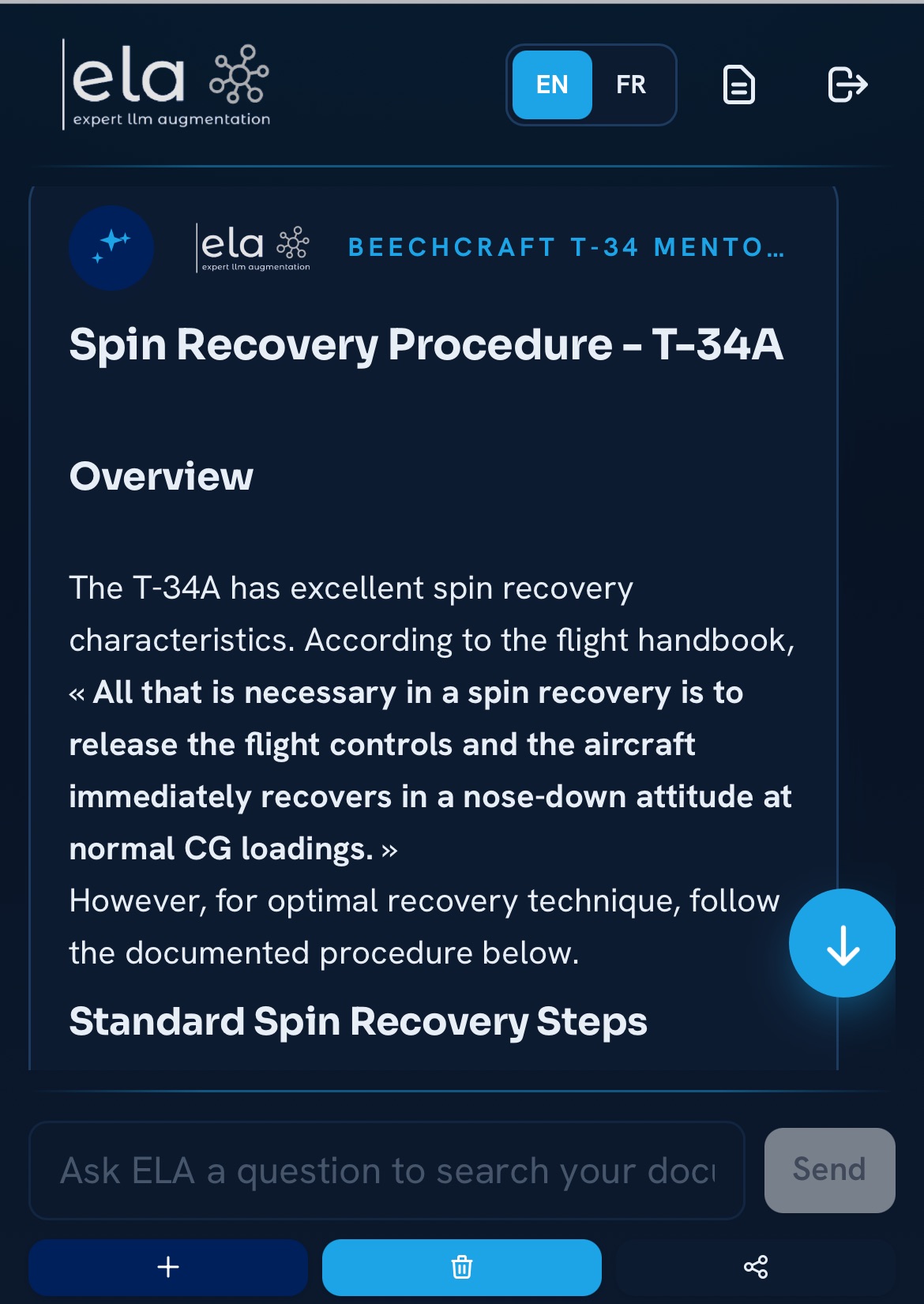
We pointed ELA (our certifiable AI for aviation maintenance) at exactly that corpus, and put the result online as a public demo. Ask it how to start the engine, how to recover from a spin, or to show you the landing-gear limit-switch assembly, and it answers in seconds, in French or English, with the source page one click away.
That part isn’t the interesting part. Plenty of tools can summarize a PDF. The interesting part is what ELA does when it doesn’t know.
Grounded, or silent
The defining behaviour of a maintenance AI shouldn’t be how fluently it talks. It should be how reliably it refuses to make things up.
When ELA answers, every claim is tied to a specific document and page. Click the citation and the actual manual opens at that exact page: not a paraphrase, not a “trust me,” but the source itself, in front of you. And when retrieval confidence is low, when the honest answer is the manual doesn’t clearly say, ELA declines and points you back to the official documentation, rather than inventing a plausible-sounding procedure. Its output is deterministic: ask the same question twice and you get the same grounded answer, not a creative variation.
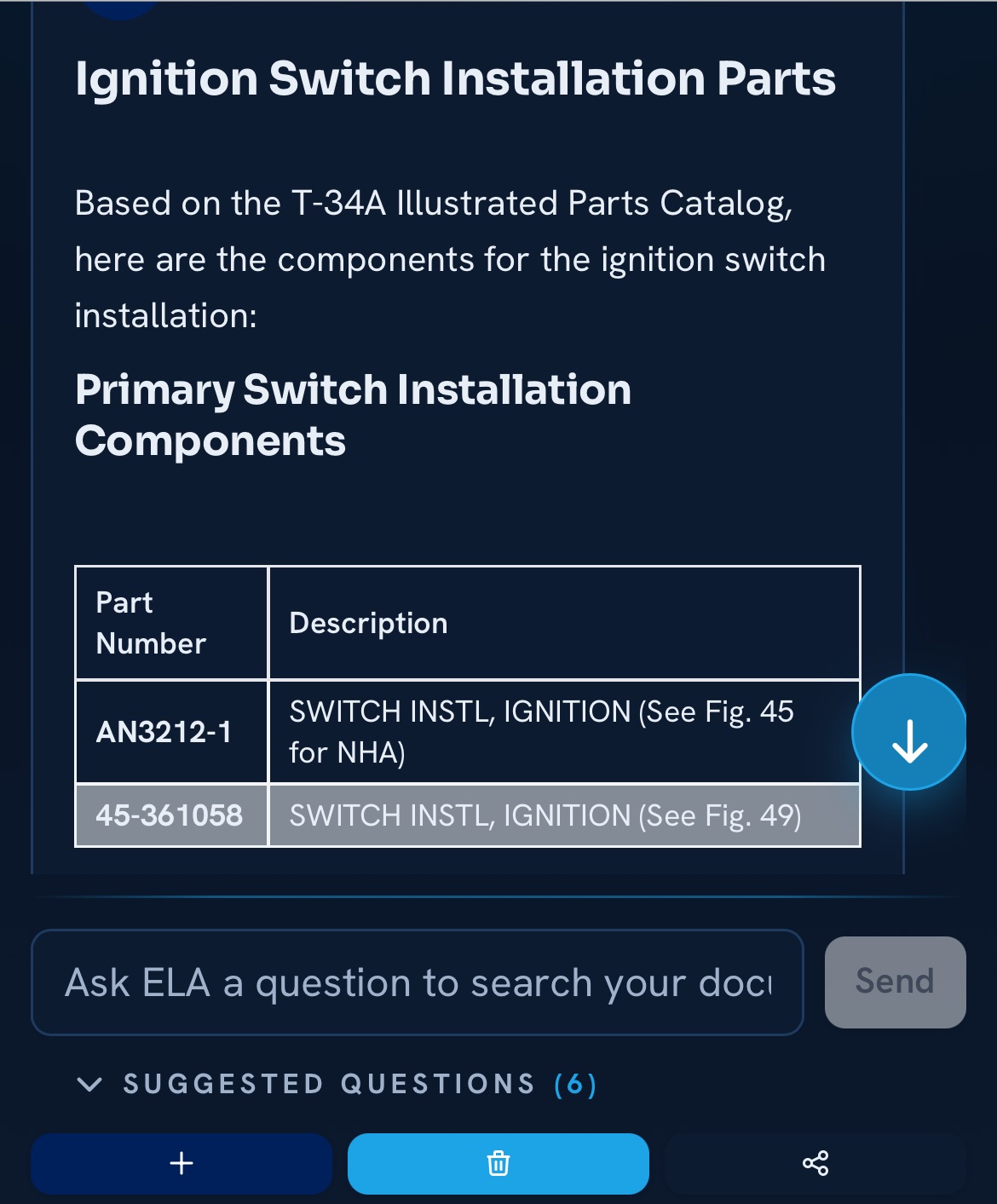
This matters most exactly where generic chatbots are most dangerous: part numbers. ELA returns part numbers from a structured database extracted from the catalogue, never from the language model’s imagination. An AI that confidently hallucinates a P/N for a flight-control component isn’t a productivity tool, it’s a hazard. So we designed that capability out.
A few more things the demo shows, all pointing the same direction:
- Ask it to “replace” or “repair” something without saying which aircraft, and it stops and asks which model first, because the wrong procedure for the right part is still the wrong procedure.
- Every result carries a confidence score and its source corpus, so you can see why it surfaced.
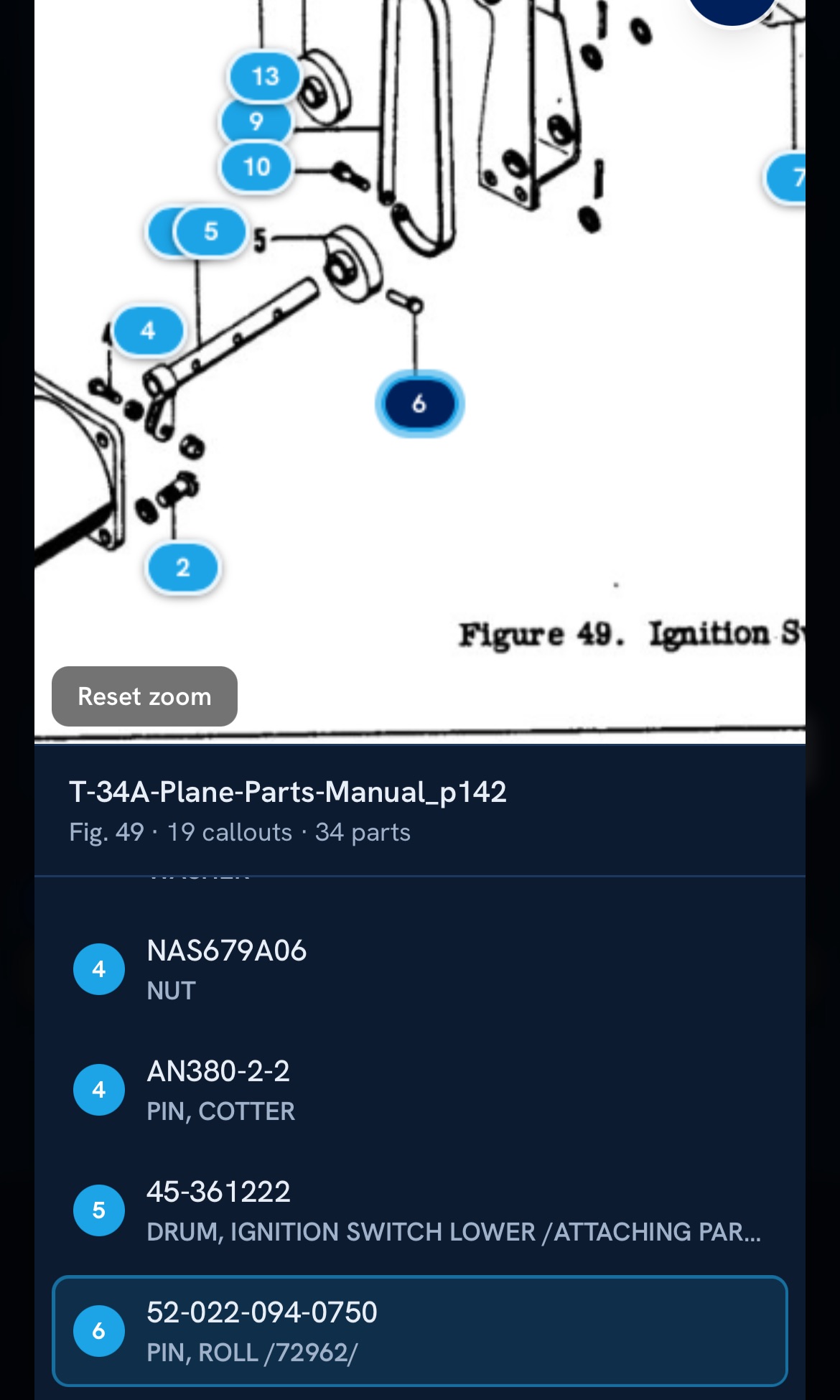
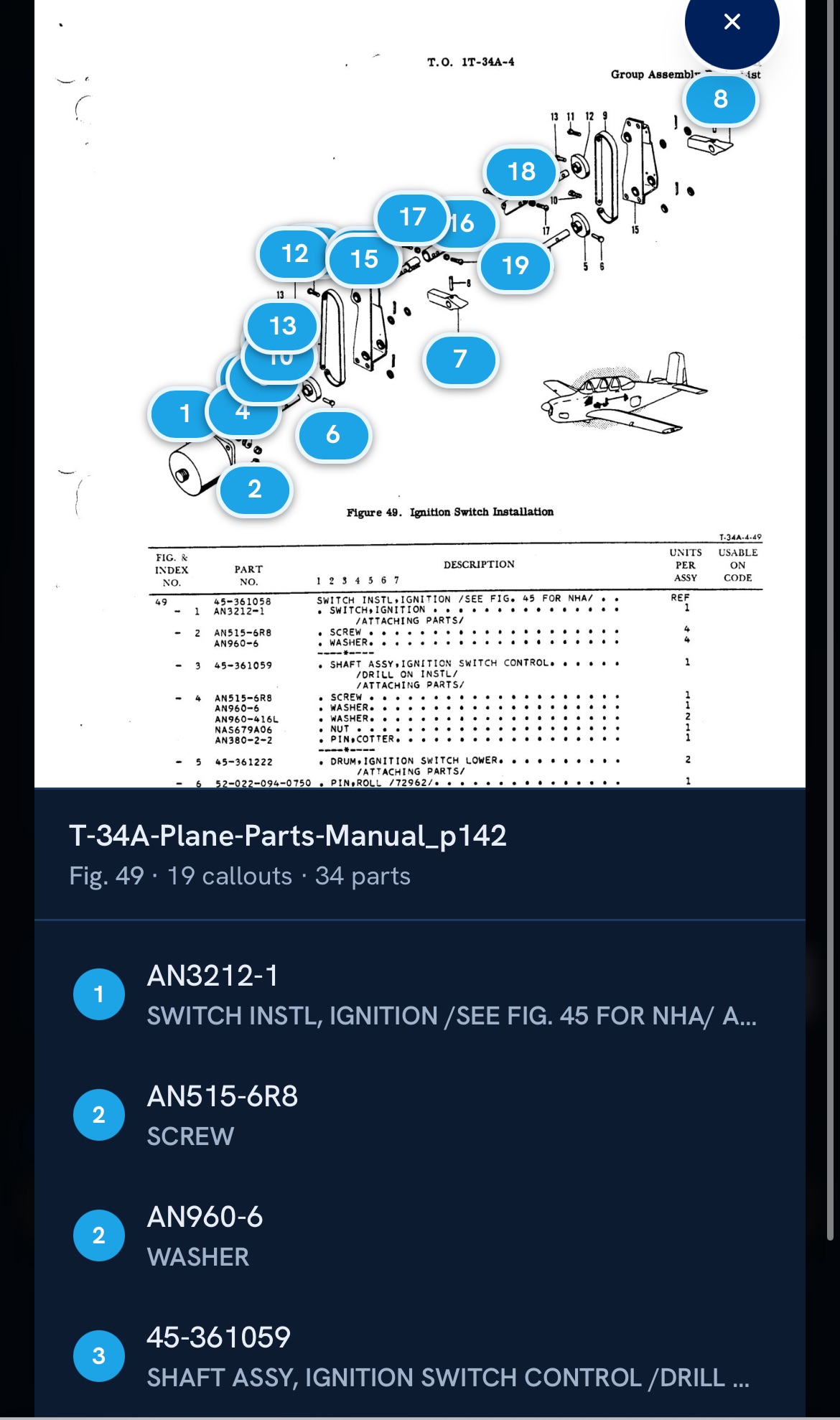
- The interactive parts viewer lets you click a component on an exploded diagram and trace it to its entry, the same cross-check a mechanic does by hand, faster.
- Content is integrity-hashed and every conversation is auditable, because in continuing airworthiness (the demo maps to EASA Reg. 1321/2014) “the AI said so” is never an acceptable record.
Why a sixty-year-old trainer
We could have built a slicker demo on a current airframe. We chose the T-34A deliberately, for a reason that has nothing to do with nostalgia: its manuals are in the US public domain.
That let us prove ELA on real aviation maintenance documents, genuine Technical Orders, genuine IPC complexity, genuine 1950s formatting that trips up lesser pipelines, without touching a single page of anyone’s proprietary data. The capability is the same whether the corpus is a public warbird manual or a confidential modern one. So we can show you precisely what ELA does, on documents we’re free to share, and let the demonstration speak for itself.
There’s a quiet principle in that choice. In aviation, data is sensitive, and trust is earned slowly. A maintenance AI that requires your crown-jewel documentation before it can show its worth is asking for trust it hasn’t earned yet. We’d rather earn it first.
The same line, in the hangar
Our flight-performance app makes a point we keep coming back to: automation should remove the friction, never the responsibility. ELA is that same idea, moved from the cockpit to the hangar.
It reads faster than any human, never loses its place in 400 pages, and never gets tired at the end of a shift. But it does not sign off the work. The mechanic does. ELA’s job is to put the right page, the right part, the right procedure in front of the person who is accountable for the aircraft, and to be honest, visibly and by design, about the edges of what it knows. The demo even says so on screen: verify responses with discernment.
What we learned
- “I don’t know” is a feature, not a failure. The engineering effort went less into making ELA talk and more into making it stop: refusing low-confidence answers, pulling part numbers from data instead of prose. That restraint is the product.
- Old documents are the honest stress test. A 1958 scanned manual with dense parts tables breaks naïve pipelines. If grounding survives that, it survives the real world.
- You can demonstrate trustworthiness without demonstrating on someone’s secrets. Public-domain proof is better proof, because anyone can check it.
This is what we mean by AI quietly reshaping aviation: not an oracle that replaces the engineer, but a tool that hands them the source, every time, and is unafraid to say when the source runs out.
Try the T-34A demo yourself: ask it anything about the Mentor and click through to the page it cites, at demo.ela.amenai.net. And as always: the AI finds the page. You make the call.