
Every takeoff begins with a small act of arithmetic that most pilots do in their heads, badly.
How much runway do I actually need today: not on the manufacturer’s chart, but here, at this field, at this altitude, in this heat? The honest answer is rarely the number you’d guess. Density altitude doesn’t care about intuition. On a warm afternoon at a mountain altisurface, a +5°C swing can quietly erase 15% of your climb rate. The chart in the flight manual was right; it just wasn’t talking about today.
This is the kind of problem we built Performance for, and this month the French ultralight federation’s magazine, ULM INFO #130, ran a feature on its second version. We’re proud of that. But the recognition isn’t the story. The story is what the app says about where automation belongs in a cockpit, and where it doesn’t.
Automating the tedious part, not the responsible part
There’s a loud version of “AI in aviation”: autonomy, agents flying the aircraft, the human as a backup. That’s not the version we ship.
The quiet version is more useful and, frankly, more honest. A pilot preparing to depart has a stack of small, error-prone calculations to do: adjusted takeoff distance, corrected climb rate, how much of the runway they’ll actually use, the density altitude that drives all of it. None of these are hard. All of them are tedious, and tedium is where mistakes hide, especially under time pressure on a hot strip with a passenger waiting.
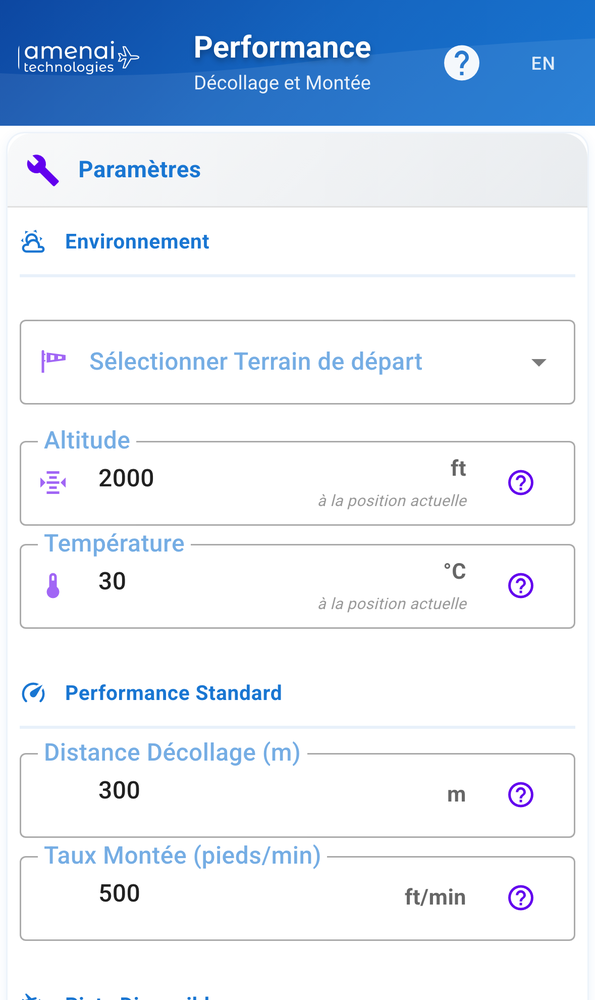
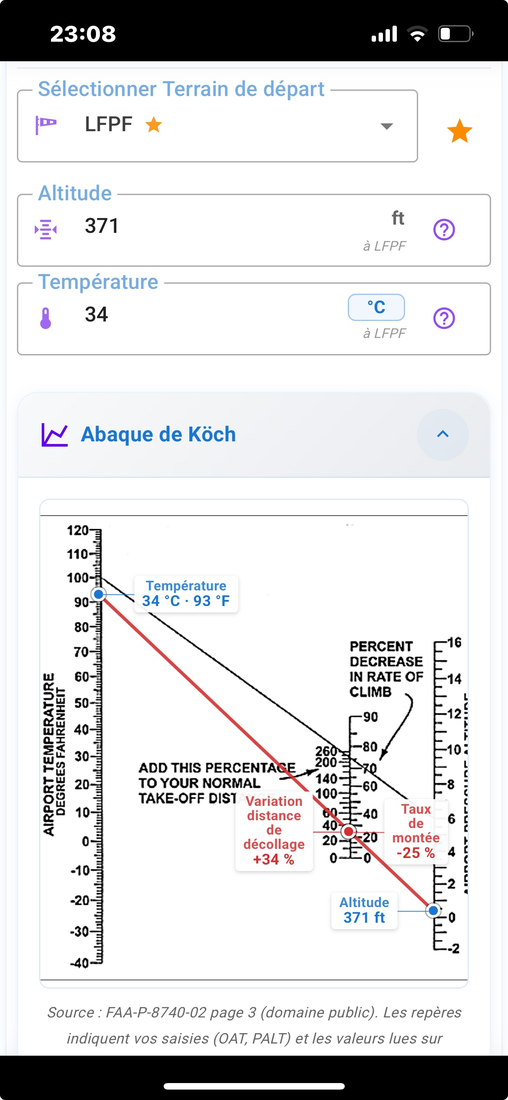
Performance does that math instantly. You enter your machine’s manufacturer figures, it pulls the field elevation and current temperature (29,000+ airfields, searchable by ICAO code or name, with live weather via Open-Meteo and optional GPS), and it returns the four numbers that matter, computed in real time against a validated density-altitude model: the ISA standard and the Koch curve, the same physics every instructor teaches, just executed without the friction.
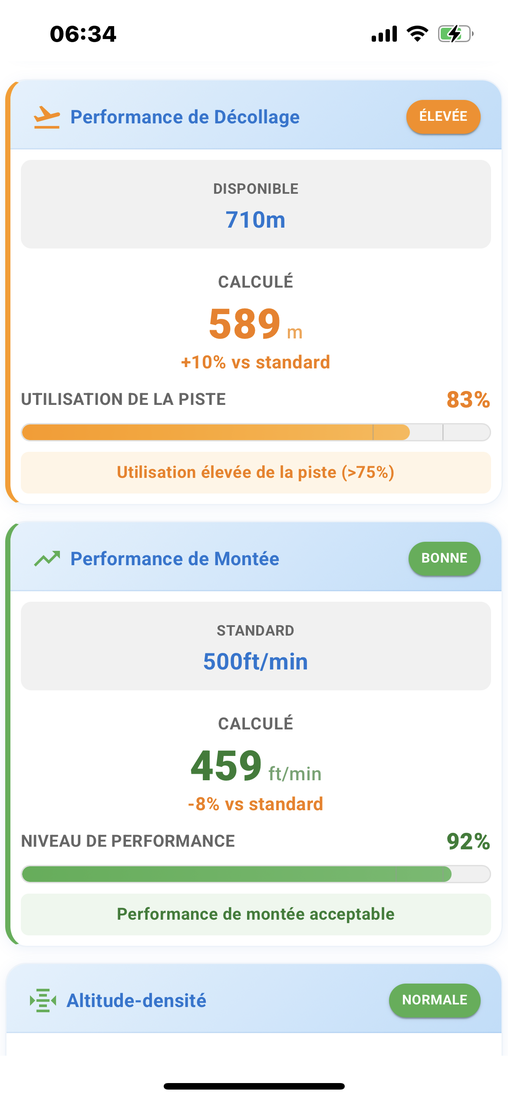
That’s the whole design philosophy: remove the friction from the calculation, never the judgment behind it.
The line we refuse to cross
Here’s the part we think about most, and the part that makes this an AI-in-aviation story rather than a calculator story.
Performance is, in our own words, an outil d’aide à la décision, a decision aid. The pilot in command remains solely responsible for verifying every calculation, evaluating the conditions, making the go/no-go call, and conforming to their aircraft’s flight manual. The app says so, plainly, on screen. The numbers are indicative; they get checked against the official manual, with safety margins added, with wind and runway slope and surface considered, and “when in doubt, wait for better conditions.”
We could have hidden those caveats. Software tends to want to feel authoritative: confident numbers, clean green checkmarks. But in a safety-critical domain, a tool that overstates its own certainty isn’t helpful, it’s dangerous. The hardest engineering decision in Performance wasn’t the Koch-curve math. It was designing an interface that’s genuinely useful and relentlessly clear that it is not the one flying the aircraft.
That’s the principle we carry into everything at amenai, from this app to our certifiable AI work in maintenance: automation earns trust by being honest about its limits, not by hiding them.
What it looks like in the real world
Xavier Ulliana (president of CRULM Sud, ULM instructor, mountain pilot, and co-initiator of the project with us back in 2024) put it better than we could:
“In the mountains and on the flats, density altitude isn’t a theoretical notion, it’s a daily reality that shapes every takeoff. With Performance, I systematically check my figures before operating from an altisurface. What I value most is being able to show my students, concretely, the impact of each parameter. When you’re training pilots who are about to fly, seeing that +5°C can cut climb rate by 15% lands far harder than any classroom lesson.”
That last point is the one that stuck with us. The tool’s best feature turned out not to be the answer it gives, but the understanding it builds. A student who watches the climb-rate number fall as the temperature ticks up has learned something a static chart could never teach them.
What we learned
- Trust is an interface problem, not just an algorithm problem. The math was the easy 20%. Communicating uncertainty honestly was the hard 80%.
- The best automation makes humans better, not redundant. Performance’s quiet win is pedagogical: it teaches the physics it computes.
- 6,000+ downloads of v1 told us the need was real. Pilots were already doing this math. We just removed the part where it’s easy to get wrong.
This is what we mean by AI quietly reshaping aviation. Not a robot in the left seat: a tool that does the tedious arithmetic flawlessly, hands you the result, and never once forgets who’s the captain.
Performance is free on the App Store and Google Play, and in your browser at calculator.amenai.net. It works partially offline and covers 29,000+ airfields. Read the ULM INFO #130 feature, or try it from the field next time you fly. And as always: fly safe, and stay the one in command.