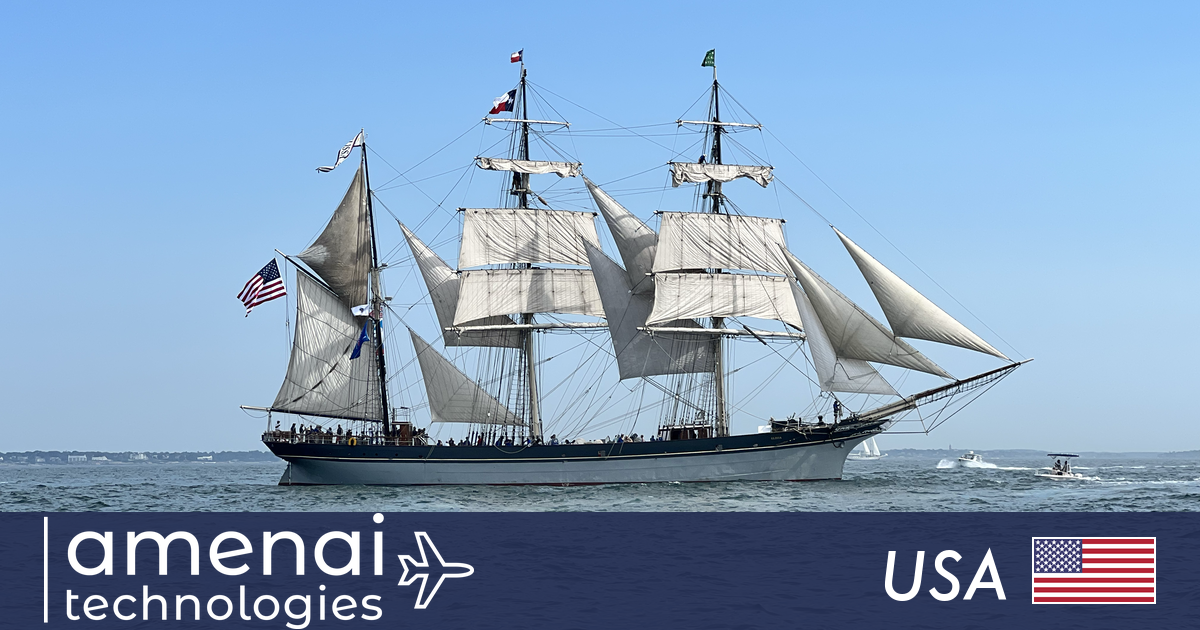
amenai technologies is now operating in the United States.
We announced it in June: Innealta LLC, a Massachusetts company, operates under the registered trade name “amenai technologies, USA” as the authorized distributor of ELA, our platform that grounds large language models in verified document corpora, with Tom O’Hare as Director. The scope covers both of our worlds: aviation and marine.
One principle crossed the Atlantic with us. In France, we tell our customers that their data is designed and hosted in France, under their control. In the United States, the same commitment holds in mirror image: US enterprise customers get a US data-residency option. Sovereignty is not a French quirk; it is how AI earns trust in regulated industries, on either side of the ocean.
The proof is already at sea
This is not a plan waiting for a first customer. The engine is already working in American waters.
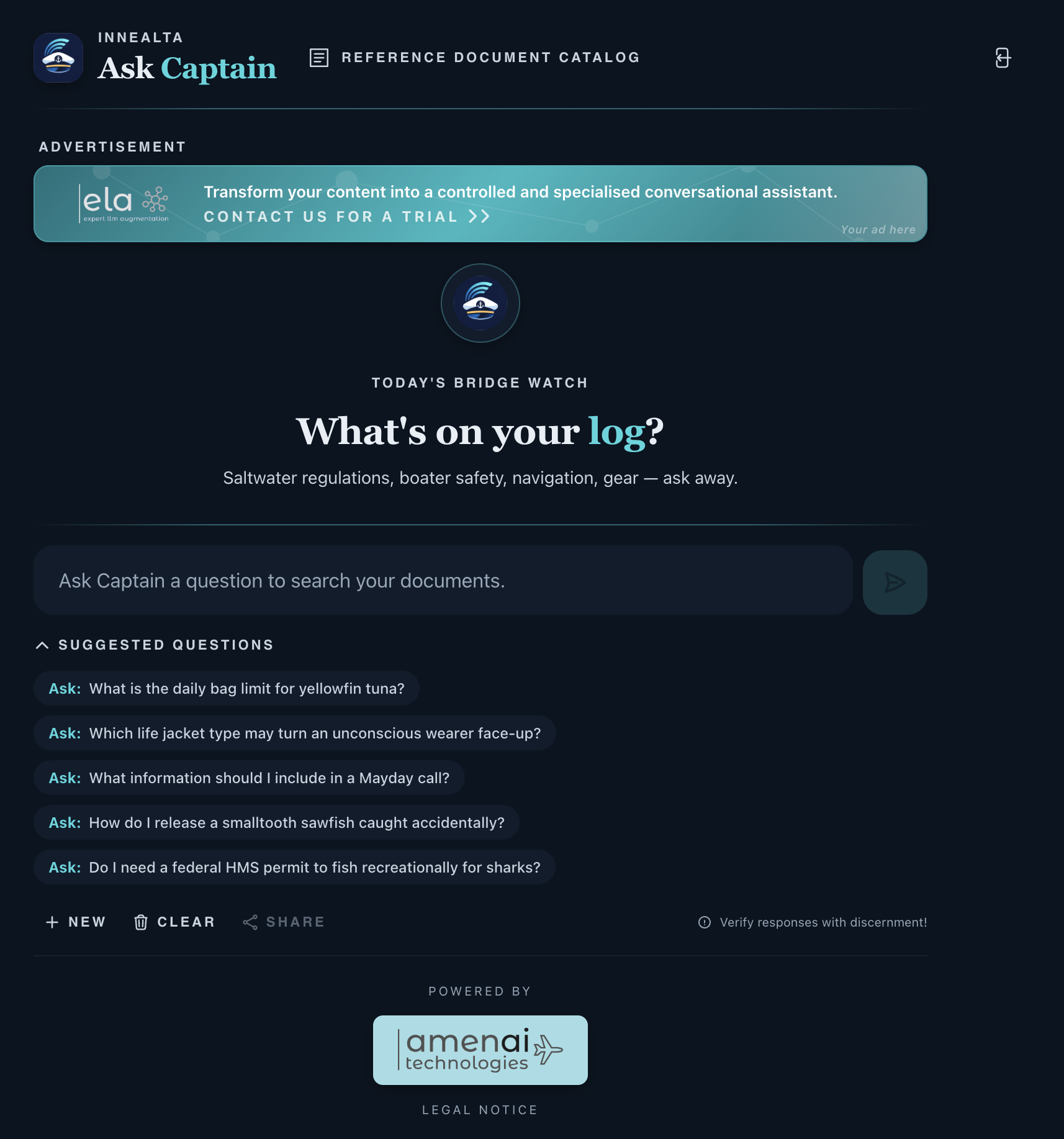
Ask Captain is the question-and-answer feature inside Boater Briefer, the boating companion app for iOS and Android. Behind it runs the same ELA engine we demonstrated last month on the maintenance manuals of a 1958 Beechcraft T-34A. This time it is pointed at 51 US marine regulatory and safety publications, nearly 5,820 pages:
- the NOAA Coast Pilot books, the ten-volume navigation companion to US coastal waters;
- the US Coast Guard Navigation Rules handbooks;
- the federal requirements guide for recreational boaters;
- NOAA Fisheries compliance guides: permits, catch limits, size and bag rules;
- safety publications on life jackets, VHF use and more.
Ask the daily bag limit for yellowfin tuna, which life jacket type may turn an unconscious wearer face-up, or what belongs in a Mayday call, and Ask Captain answers with the source one tap away. When the documents do not say, it says so, instead of guessing. The interface itself reminds you to verify responses with discernment: the decision stays with the skipper.
What it took to change domains
Here is the part we find most interesting as engineers. To go from the hangar to the harbor, we changed three things: the corpus, the domain prompt, and the vocabulary the engine uses to classify questions.
We did not change the engine. Not the ingestion pipeline, not the retrieval, not the grounding that ties every answer to a document and a page, not the refusal to answer when confidence is low. The discipline that aviation imposed on us turned out to be the product: an engine built to be accountable in one safety-critical domain transfers to the next one with a change of corpus, not a change of architecture.
That is the real meaning of this launch. Aviation maintenance manuals, marine regulations, and tomorrow any corpus where a wrong answer costs more than no answer: rail, energy, medical devices, defense documentation. If your domain runs on authoritative documents, the engine already knows how to read them.
Get in touch
For ELA in the United States, aviation or marine: amenai.net/us/contact.
For everywhere else, we remain where you know to find us: amenai.net.
The answers cite their sources. The decisions stay with you.