
A voice assistant in the cockpit is only as good as what it knows.
Last May, amenai technologies was awarded the 2026 Bourse French Tech for the Audio Virtual Copilot, a feasibility study of a voice assistant for the general aviation cockpit. The program targets the phases where pilot workload peaks: more than 32% of general aviation accidents happen during approach and landing. Before that copilot speaks its first word, something less glamorous has to happen. Someone has to turn the documentation pilots rely on into data a machine can query, verify, and cite.
That someone, this spring, was three interns. Here is what they built.
Reading the eAIP: the law of the sky, every 28 days
The French eAIP is the official aeronautical information publication: aerodromes, runways, airspaces, navaids, routes, obstacles. It is authoritative, exhaustive, and republished every 28 days on the AIRAC cycle. It is also built for human readers, not for software.
Elie Makdissi built the pipeline that changes that. It ingests each new cycle from the official XML sources and loads it into a geospatial database that software can interrogate: about 230 French aerodromes with terrain data, 778 runways with their declared distances, more than 4,400 airspace boundary records, 100 ILS installations. Where the official source lacks terrain coverage, the pipeline fills it from the French national geographic institute’s elevation data.
Because this data may one day sit under safety-critical software, the pipeline is built with certification-grade discipline: malformed data fails loudly instead of loading silently, every cycle is archived and cryptographically signed, and every load is traceable end to end.
Reading the charts: from PDF to map
Ask any pilot preparing a flight to an unfamiliar field: the VAC, the visual approach chart, is the document that matters. Runway orientations, circuit patterns, obstacles, restricted zones, all drawn for the human eye on a PDF page.
Amsan Sutharsan built an extractor that reads those charts the way a pilot does, and writes down what it sees in a form software can use. Computer vision locates the zones of the chart; a vision-language model identifies each element (runways, obstacles, circuits, parking, airspaces); a geo-referencing step pins every element to its real-world coordinates.
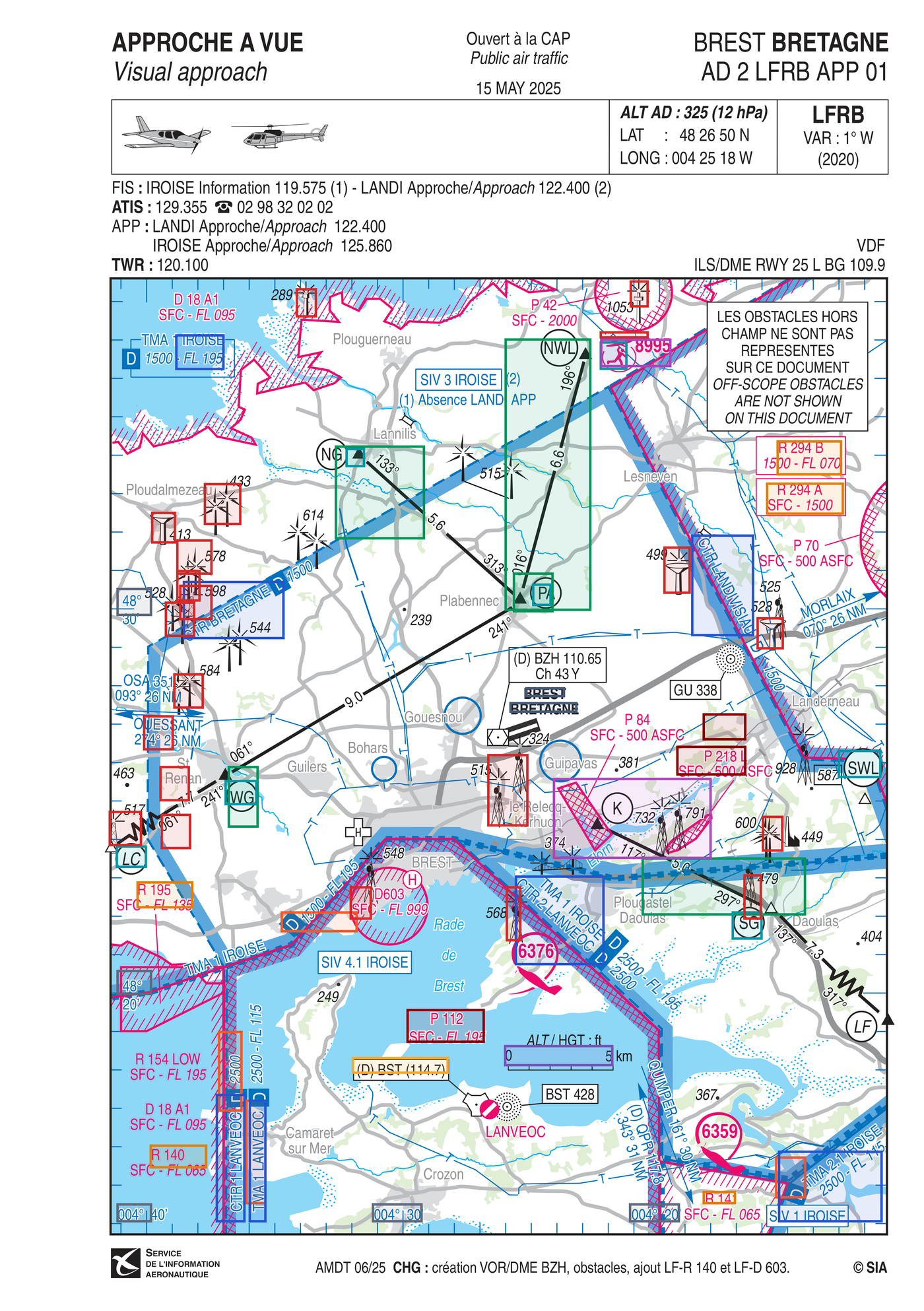
And then, the step we care most about: a human reviews the extraction in a dedicated viewer before anything is accepted. The machine extracts, the human signs off. It is the same principle that governs ELA in the maintenance hangar, applied to data production. The current pilot run covers some twenty airfields in Brittany, with the full set of 505 French VAC charts in sight.
Reading the web: widening ELA’s knowledge
Not everything a pilot or a mechanic needs lives in a PDF. Alya Ayinde built the web ingestion pipeline for ELA, our platform that grounds large language models in verified document corpora. The crawler fetches approved sites, respects their crawling rules, strips advertising and noise, chunks and embeds the content, and writes it into the same knowledge store ELA answers from, with observability and quality gates at every one of its nine stages.
The result: ELA’s knowledge base can now grow beyond documents we host, while keeping the property that makes ELA what it is. Every answer points back to its source.
Foundations first
None of these three projects makes a sound. That is the point. A copilot that speaks before it knows is a hazard; one that knows before it speaks is an assistant. Structured airspace data, machine-readable charts, and a wider knowledge base are what the Audio Virtual Copilot’s aeronautical reasoning model will stand on.
One more thing. All three pipelines were built by interns, shipped through the same review gates as everything else we write: issues, branches, pull requests, tests. We take interns seriously here, and they ship production code.
The go/no-go, as always, stays with the pilot.